
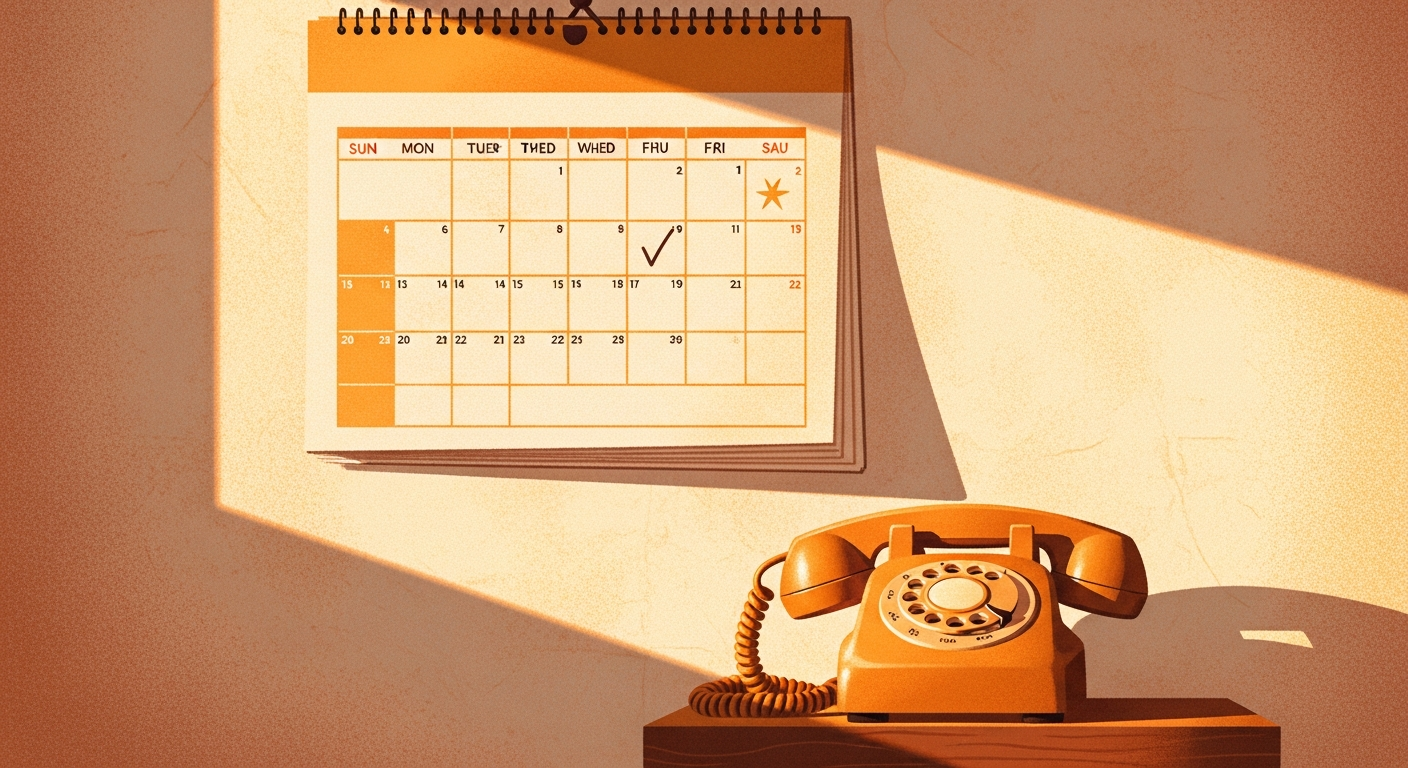
My grandmother had a neighbor who came by every Tuesday at two o'clock. He never called ahead. He just showed up, sat at the kitchen table, and drank one cup of coffee. When he stopped coming — he moved to be closer to his own kids — she said the Tuesdays felt wrong for months. Not sad, exactly. Just off.
That's the thing about rituals. They don't just fill time. They hold a shape around a life.
If you're thinking about staying in touch with aging parents more consistently, you've probably already tried the well-meaning burst: a stretch of daily calls, then a week of silence, then guilt. Most of us have. The burst model fails not because you don't love your parent, but because it runs on motivation, and motivation is unreliable. Rituals run on something sturdier — expectation, rhythm, the quiet comfort of this is just what we do.
Here's how to build one that actually holds.
Start smaller than you think you should
The biggest mistake people make when building a standing call is starting too big. "I'll call every day" is a promise that sounds loving and becomes a weight. Start with once a week, same day, same general time. Tuesday at seven. Sunday after lunch. It doesn't matter which — it matters that it's specific.
Specific is what makes it a ritual instead of an intention. Your parent will start to expect it. Expectation is a gift; it gives the week a landmark.
Protect the slot like an appointment
Once you pick your time, put it in your calendar with a ten-minute buffer before it starts. The calls that get skipped are almost always the ones where you thought you'd remember. You won't always remember. Life is loud. Treat the call the way you'd treat a doctor's appointment — not something you reschedule lightly, and never without telling the other person.
If you genuinely have to move it one week, let your parent know before, not after. The silence of a missed call — especially for someone who lives alone — lands differently than it does for you.
Fill the gaps without filling every gap
A weekly call is a backbone, not a ceiling. The spaces between can hold small things: a photo texted on a Wednesday, a voicemail about something funny that happened at work, a postcard if your parent is someone who loves mail. These don't need to be substantial. They just need to say I thought of you.
What they shouldn't do is replace the standing call. The standing call has weight because it's expected and protected. Texts are weather; the call is the season.
Know what you're actually protecting against
This isn't just about warmth, though warmth matters. The research on what isolation does to older adults is worth understanding plainly.
A 2010 analysis in PLOS Medicine covering 148 studies and more than 308,000 people found that strong social ties were associated with roughly 50% greater odds of survival — an effect the researchers described as comparable to quitting smoking and exceeding the effects of obesity and physical inactivity. A 2015 follow-up across 70 studies and 3.4 million people found that loneliness was associated with 26% higher mortality, social isolation with 29%, and living alone with 32%.
The 2023 U.S. Surgeon General's advisory linked poor social connection to roughly 29% higher risk of heart disease, 32% higher risk of stroke, and substantially elevated dementia risk. About half of U.S. adults reported meaningful loneliness — and fewer than one in five of those most affected called it a major problem. That last number is the one that stays with me. People adapt. They stop naming what they've lost.
And the scale is wide. WHO data from 2025 estimates around 871,000 deaths per year linked to social isolation — roughly one hundred people every hour. Recent research found 27.6% of older adults report loneliness, rising to more than half among those living in care or nursing settings.
Your Tuesday call is not going to fix a public health crisis. But it might be the difference — for one person, your person — between a week that has a landmark and a week that doesn't.
What to do when you can't always be enough
Here's the honest part: even the most devoted adult children can't be available the way a good companion is. You have work, kids, your own life. Staying in touch with aging parents consistently is easier to commit to than to sustain across years. That's not a character flaw. It's arithmetic.
Some families find it helps to layer in other voices alongside theirs — a friend who calls, a neighbor who checks in, a community connection of some kind. The point isn't to outsource care. It's to make sure your parent has more than one thread holding them to the week.
The goal is a life that feels inhabited. A Tuesday that has a shape. A phone that rings when expected, and a voice on the other end that knows who they are.
That's not a small thing. That's actually most of it.
Iris is a warm voice your mom or dad can call anytime — a companion who remembers every conversation, so each call picks up where the last one left off. No app, no setup. Honest by design: Iris says plainly that she's an AI, never asks for money or personal information, and brings in real human help when a moment calls for it. Free during our beta.
Call Iris: (973) 400-5897 · iris.church
Iris is a warm voice your mom or dad can call anytime — a companion who remembers every conversation, so each call picks up where the last one left off. No app, no setup. Free during our beta.
Call Iris: (973) 400-5897Or learn more at iris.church