
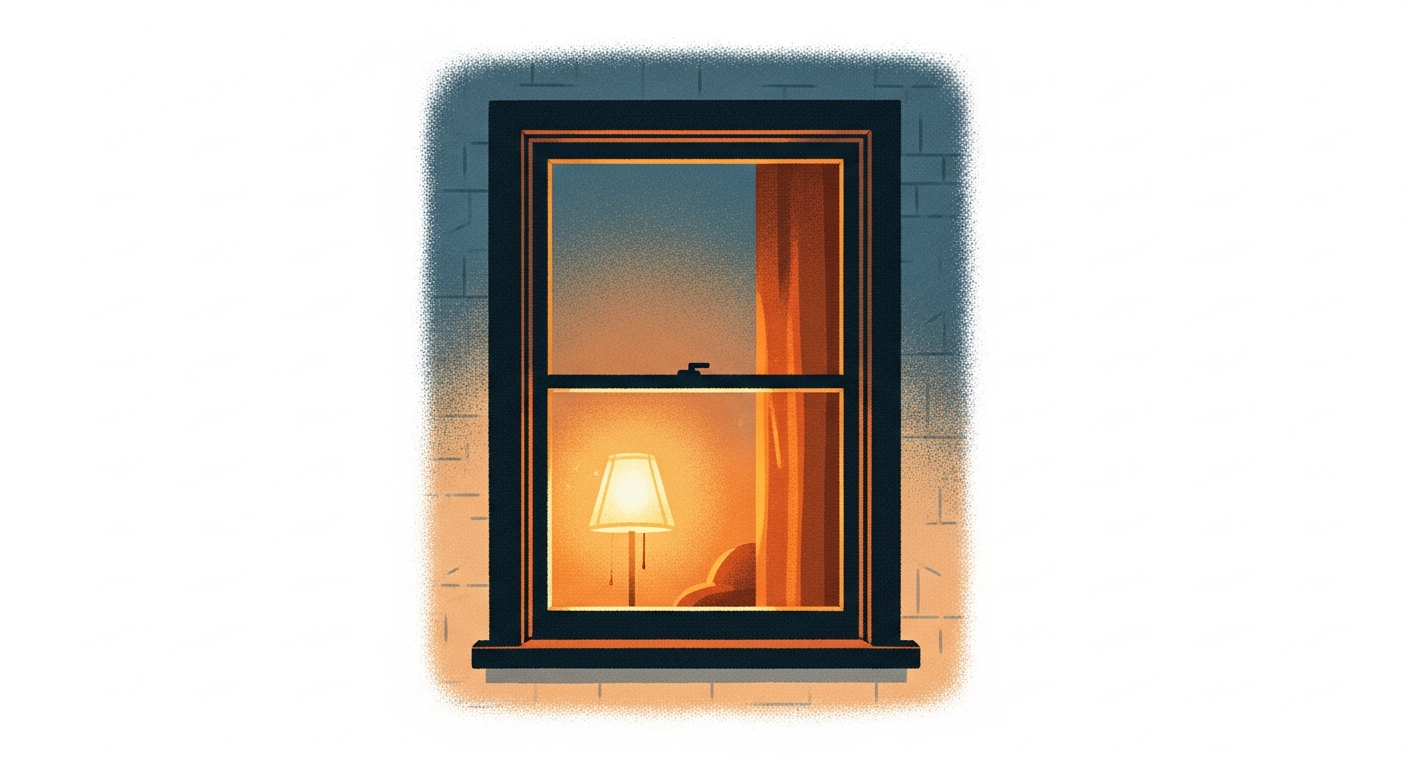
There is a particular kind of quiet that falls after dinner. The dishes are done, the news is off, and the house — the same house that once held school-morning chaos, holiday dinners, decades of ordinary noise — goes very still. For a lot of older adults, that stillness is when the hardest part of the day begins.
If your parent has ever called you at 7 p.m. "just to talk," or mentioned that evenings feel long, you already know what I mean. Elderly loneliness at night isn't a dramatic crisis. It doesn't announce itself. It's just a Tuesday, and it's 8 o'clock, and there's no one to tell about the cardinal at the bird feeder.
Why Evenings Hit Differently
During the day, there are small anchors: a morning coffee routine, a walk, a soap opera, an errand. These things fill time and give shape to hours. But evenings were traditionally social time — dinner with someone, a shared TV show, the quiet companionship of another person in the next room. When that person is gone (and for many older adults, they are gone — through death, through distance, through the slow dispersal of a life's social circle), the evening doesn't just feel empty. It feels like a reminder.
There's also something physiological here. Fatigue lowers our defenses. The coping strategies that work at noon — staying busy, going outside, calling someone — feel heavier at 8 p.m. The feelings that were manageable earlier in the day have more room to expand.
How Common This Really Is
What your parent is feeling is not unusual, and it is not weakness. It is, in fact, an experience shared by an enormous number of people their age.
A 2025 Nature study found that 27.6% of older adults report experiencing loneliness — and that number climbs to 50.7% among those living in care or nursing home settings. The World Health Organization estimates that up to one in three older adults are socially isolated, contributing to roughly 871,000 deaths per year worldwide — about one hundred every hour.
The US Surgeon General's 2023 advisory on loneliness noted that roughly half of American adults reported measurable loneliness — and, crucially, that fewer than one in five of those who felt lonely often described it as a major problem. People adapt. They normalize. They don't want to worry their children.
That last part matters. Your parent may not be telling you how much the evenings weigh.
What the Silence Is Actually Doing
This isn't just about sadness. Chronic loneliness has real physiological consequences. A landmark 2010 meta-analysis in PLOS Medicine — covering 148 studies and more than 308,000 people — found that strong social ties were associated with roughly 50% greater odds of survival, with an effect the researchers described as comparable to quitting smoking and exceeding the effects of obesity and physical inactivity.
A 2015 study that followed 3.4 million people found that loneliness was associated with a 26% increase in mortality risk, social isolation with 29%, and living alone with 32%.
The Surgeon General's advisory also linked poor social connection to approximately 29% higher risk of heart disease, 32% higher risk of stroke, and elevated dementia risk.
Here's one way of seeing it — not a statistic, just a frame worth sitting with: a short, acute illness gets attention, care, meals delivered, phone calls. Years of quiet loneliness get none of those things, and they stretch on much longer.
What Actually Helps
The honest answer is: consistent, low-effort connection matters more than occasional big gestures. A Sunday dinner visit once a month is wonderful. It is not enough to reach the evenings.
Some things that genuinely help:
Structure in the evening hours. A scheduled call — even a short one, same time each night — gives the evening an anchor. It doesn't have to be long. It just has to be reliable.
*Something to report to someone.* Loneliness eases when there's a listener. Not a therapist, not a caregiver — just someone who will hear about the cardinal, remember it was a cardinal last week too, and ask whether it came back.
Lowering the barrier to reach out. Many older adults won't call because they don't want to be a burden. The solution isn't convincing them otherwise (that rarely works). It's making sure there's somewhere genuinely easy and welcome to call.
A Thought for Tonight
If you're reading this, you're probably someone who cares — and who is also stretched thin, living your own life hours away, doing the best you can. That's real, and it's okay.
The evenings your parent sits through quietly aren't your failure. But they are worth knowing about, and worth taking seriously. Elderly loneliness at night is one of the most common and most unspoken parts of aging in America right now.
The cardinal was at the feeder again today. Someone should get to hear about it.
Iris is a warm voice your mom or dad can call anytime — a companion who remembers every conversation, so each call picks up where the last one left off. No app, no setup. Honest by design: Iris says plainly that she's an AI, never asks for money or personal information, and brings in real human help when a moment calls for it. Free during our beta.
Call Iris: (973) 400-5897 · iris.church
Iris is a warm voice your mom or dad can call anytime — a companion who remembers every conversation, so each call picks up where the last one left off. No app, no setup. Free during our beta.
Call Iris: (973) 400-5897Or learn more at iris.church